


Import from Twitter/X
How do I save Tweets from Twitter to Readwise?
You can start saving Tweets and Twitter threads to Readwise by connecting your Twitter account to Readwise from the dashboard > Import > Twitter.
Once connected, you can save an individual tweet by replying with @readwise save as shown below:

Or you can send Tweets to @readwise via DM. If you DM the Tweet, any text you include in the message will be treated as a note in Readwise. (Great for inline tagging!)
You can save entire Twitter threads by replying with @readwise save thread as shown below:

You can also DM the thread to @readwise with the word thread or t in the message. Any text you include in the message will be treated as a note in Readwise.
If your Twitter account is set to private, please message us at hello@readwise.io to follow you on Twitter so that we can see the tweets/threads you save and import them into your library for you.
You can still tag "@readwiseio save" in your Tweets if you want, or you can use @readwise and save yourself 2 characters—both work :)
Can I save Tweets to Readwise by bookmarking them?
Yes! Bookmarking a tweet on X is the easiest way to save it. Bookmark importing is turned on automatically by default when you connect your account, and new bookmarks are imported once a day.
You can manage the import from the Twitter settings page, found from the dashboard > Import > Twitter. The page shows every Twitter save option organized by destination, so you can decide exactly which kinds of saves go to Readwise and which go to Reader.
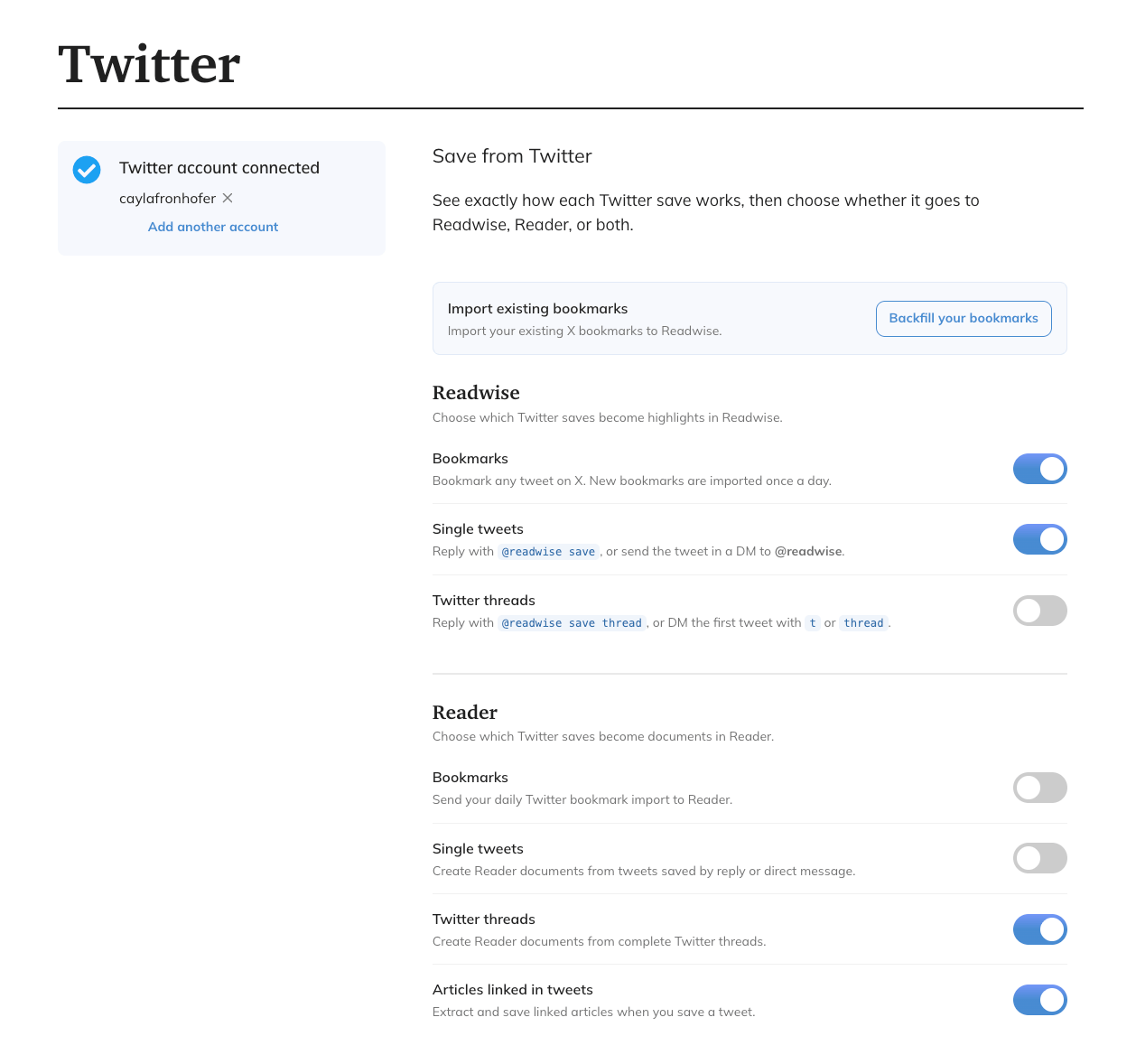
If you haven't connected your Twitter account yet, you'll see an Authenticate X link in place of the Bookmarks toggles.
This feature is experimental and relies on the stability of Twitter's API. If you encounter any issues, please let us know at hello@readwise.io so we can continue building a better integration.
How do I import my old Twitter bookmarks?
Bookmarks you saved before turning on the import can be brought in too. On the Twitter settings page, find the Import existing bookmarks section and click Backfill your bookmarks.
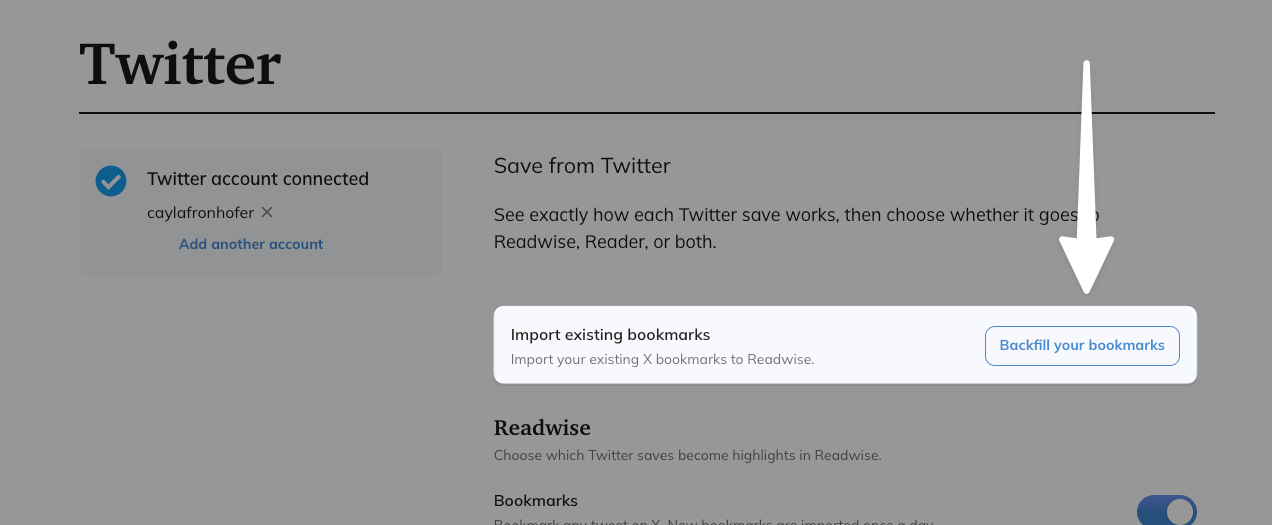
The backfill runs through the Readwise browser extension, which is available for Chrome and Firefox. If you don't have the extension installed, you'll be prompted to add it first. In Firefox, you'll also be asked to allow the extension temporary access to X before the import starts, and that access is removed automatically once the import finishes.
Backfilled bookmarks keep their original bookmark dates, and they follow the same destination settings as your regular imports, so they'll land in Readwise, Reader, or both depending on your toggles.
Can I choose whether my tweets go to Readwise or Reader?
Yes! Every type of Twitter save can go to Readwise, Reader, or both, and the Twitter settings page shown above lets you configure them all in one place:
- In the Readwise section, choose which saves become highlights in Readwise: Bookmarks, Single tweets, and Twitter threads.
- In the Reader section, choose which saves become documents in Reader: Bookmarks, Single tweets, Twitter threads, and Articles linked in tweets, which extracts and saves the articles linked in the tweets you save.
If you use Readwise without Reader, single tweets and Twitter threads always save to Readwise, so you'll see an Always on badge in place of those two toggles.
The same settings also appear in Reader under Preferences > Integrations. Both pages control the same underlying settings and stay in sync, so you only need to configure them in one place.
How do I prevent Twitter thread duplicates in Readwise and Reader?
By default, individual Twitter posts will be saved as a highlight to your Readwise account, while Twitter threads will be saved to Reader as an article.
If your threads or single tweets are appearing in both places, it’s possible that your Twitter settings are causing an overlap.
To adjust this, click into your Preferences in Reader and select Integrations. Click the Settings button to expand the options (see screenshot below). To reduce duplicates, make sure that each type is only checked on for either Reader or Readwise, rather than both.
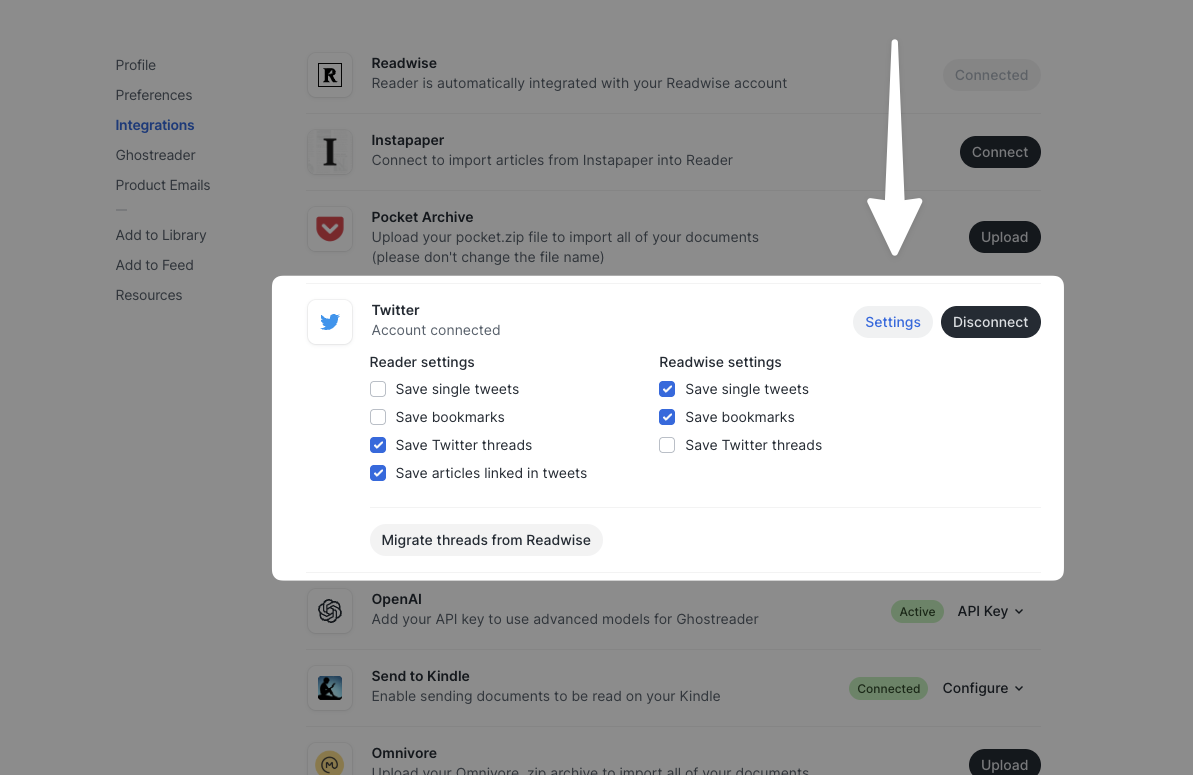
You can also adjust the same destination settings directly on the Twitter settings page in Readwise, as described above.
Why does Readwise need both read and write Twitter permissions?
Protecting the privacy of our users is important to us, but unfortunately Twitter's current API provides only three permission levels for developers:

Source: https://twitter.com/settings/applications
At this time, this is the only way to enable our users to share Tweets to their own timelines as well as save Tweets to their Readwise accounts.
However, as an important note: we will never tweet anything without your permission, and we do not read any data but your tweets to @readwise.
Can I connect a second Twitter account to Readwise?
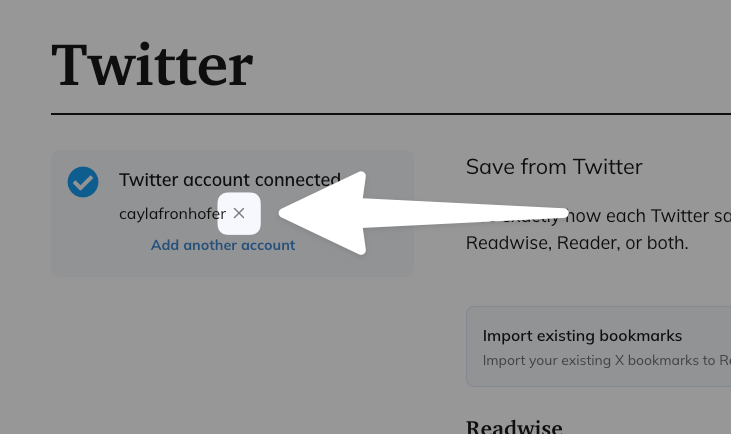
You can connect multiple Twitter accounts to Readwise from the Twitter settings page. On the left side of the page, you'll see a list of currently connected Twitter accounts. To connect a new one, click Add another account.
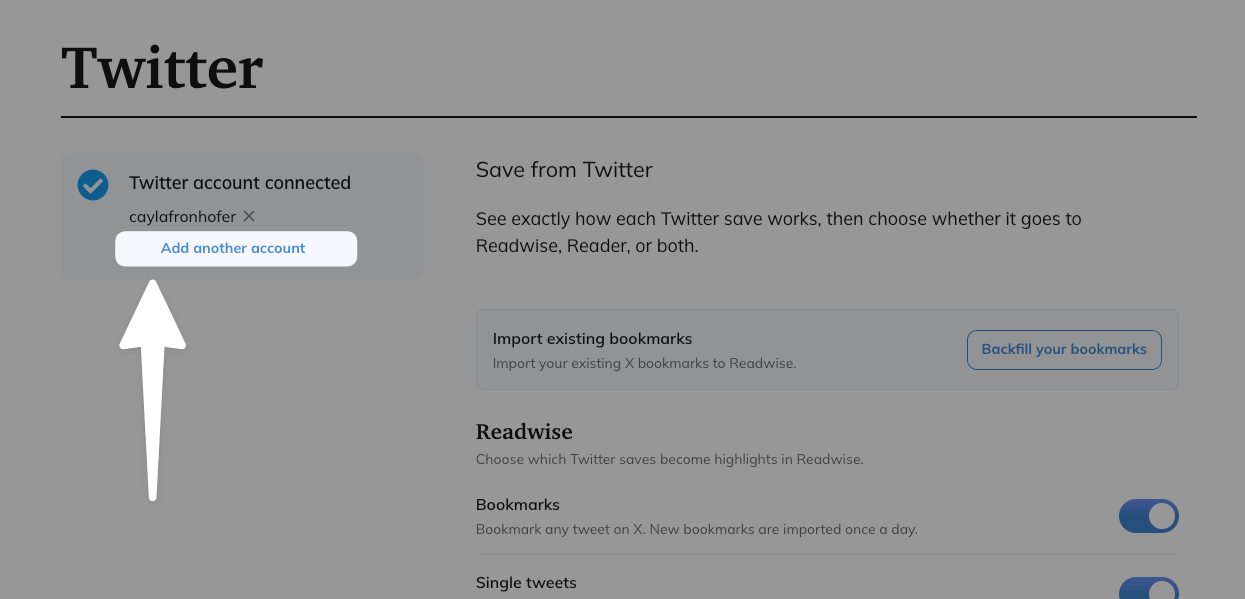
This will open the Twitter authorization page and allow you to grant Readwise permission to access your account. Note that you'll want to be logged into the target account (or logged out entirely) before clicking this, since it will prompt the authorization for whichever account is currently logged in.
To remove a connected account, click the gray X to the right of the account name.